
Virtualization ala KVM got a big boost this week when industry heavyweights Intel, IBM, HP, and Red Hat announced their new Open Virtualization Alliance. The effort is geared toward encouraging greater use of KVM as an open source virtualization solution. It’s also a shot across the bow of x86 virtualization leader VMware; it seems designed to erode VMware’s control over virtualization as well as put some pressure on their margins.
In a Reg article here, Red Hat’s VP of Cloud Computing Scott Crenshaw was very upfront about whittling VMware down to size. The other vendors, all solid past partners of VMware’s, didn’t make any VMware-specific comments; they talked about offering a wider range of choice for customers. This makes sense, given that Red Hat pushes KVM more than any other solution.
It’s also no surprise to see the server vendors and Intel remaining neutral – they’ll be happy to support whatever solution the end-user wants, but would probably prefer it if VMware wasn’t as powerful as it is now.
In the 2010 edition of our annual x86 Server Vendor Preference survey, we asked quite a few questions about virtualization. For the first time, we asked how many different x86 virtualization schemes our respondents were currently using.
We were a bit surprised to see that only a small number (29%) were satisfied with a single virtualization mechanism (see chart below). An almost equal number (26%) were using four or more different virtualization packages, and almost half of them were using two or three. (See our document outlining those results here.)
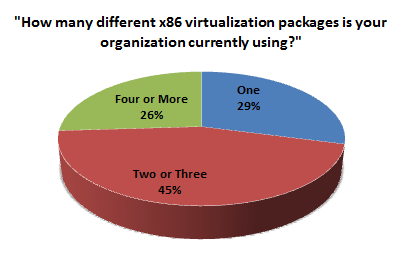
The reasons for this are twofold. First, plenty of customers are still tire-kicking x86 virtualization and have yet to settle on a standard. But we believe that the majority of customers have decided that they aren’t going to confine themselves to a single virtualization solution. For cost and technical reasons, particular virtualization schemes are better choices than others on certain workloads. So it’s logical that they’d use whatever tool is best for the job, right?
We also asked which virtualization packages our respondents were using. VMware is in more than 80% of these data centers, and more than half said it was their standard or default virtualization choice (see chart below). KVM was in use in just over 30% of our respondents’ organizations, but very few had made it their virtualization method of choice.
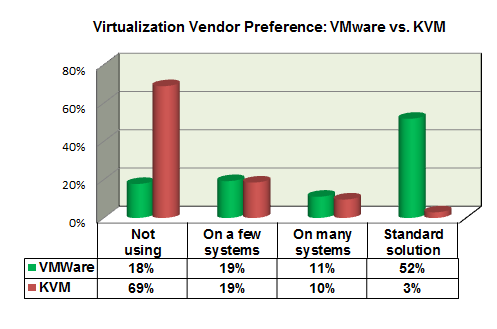
However, KVM has a lot going for it. First, it’s not closely tied to a specific vendor, unlike Microsoft’s Hyper-V and Oracle’s various Xen distributions. KVM has a good technical reputation if not the technical sophistication or range of VMware or even Xen offerings.
And KVM is embedded in the Linux kernel as opposed to the bare metal approach of VMware and Xen. This means that Linux users have KVM built into their distribution, while Xen and VMware are add-ons.
KVM doesn’t have the price tag of VMware, either; supported KVM is much less expensive, particularly for very large use cases.
Assuming that the Alliance can help KVM improve on the technical front – adding more functionality and availability features – we think that KVM will definitely see an upswing in interest from a much broader set of customers.
We don’t expect to see KVM knock VMware off of their pedestal, and it’s not a kill shot for Xen or Hyper-V either. But it does roil up the waters a bit and give customers a wider variety of ‘safe’ choices for x86 virtualization – which is always a good thing. Right?