
Taking Our Survey: Free; Reading the Comments: Priceless

Recently, we shared some preliminary results from our annual x86 enterprise user survey. The topic of that article was the economy, and what it’s done to our survey respondents’ 2010 IT budgets. You can see that article here and take the survey yourself here.

Now we’re taking a look at a sampling of the qualitative answers we received in the survey when we gave the respondents a chance to tell us about the good, the bad, and the just plain stupid attempts to cut costs. As you’ll see, these plans are ill-fated due to a combination of short-term thinking, utter incompetence, and probably a heaping helping of toadying as well.

Read More
Our Latest x86 Survey: Get Your Two Cents In

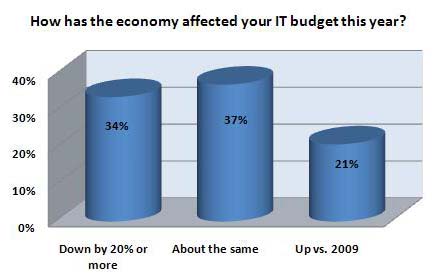
Preliminary results from our 2009/10 x86 Vendor Preference Survey show that the economy has had a considerable impact on IT spending among our survey respondents. While this is perhaps a “Duh, dumbass” finding, it does give us some data to hang our hats on. We want to stress that these results are tentative, as the survey is still out in the field and could well change as more responses are received. But, we also wanted to share a bit of interesting data and maybe even induce more of you to take the survey.

‘Read More’ to see the results and the participants’ observations… or to take the survey yourself…

Read More

Optimizing Desktop/Mobile Support: Real, or Mirage?

The ideal client computing solution doesn’t yet exist. The traditional model is very expensive, requiring lots of troubleshooting and 1×1 support to keep users up and running. Left uncontrolled, users will add more applications or inevitably use their systems for both work and personal tasks. This anarchy leads to more system problems and thus more support. Organizations typically try to minimize these problems by locking down the PC configuration – sort of the old-style Soviet Politburo approach, which leads to unhappy users burning effigies of CIOs.

Read More

9TB in 20 minutes? Sign me up!

OK, I’m a sucker for anything that does something a lot faster – even if I don’t quite understand how it does it. So I have to blog a least a little bit about IBM’s recent announcement; they’ve lit a fire under the task of assessing data quality with a newly patented (and presumably shiny) algorithm. What got my attention was this result:  Using this new method, they were able to accurately validate 9TB of data in 20 minutes  – as opposed the 24 hours plus that traditional methods would have taken on the same hardware.

That’s pretty sporty performance, in my mind,

Read More

Oracle + Sun: Whither HPC?

There hasn’t been a lot of talk yet from Oracle about their plans for HPC now that the Sun purchase has been consummated. From what I can tell, it’s not that Oracle is necessarily holding anything back; it’s more that their approach to the market is still being shaped up. The big job was getting the systems roadmaps in place and communicated to the world – and there still are some who will argue that Oracle hasn’t been clear enough on that issue.

However: it looks like almost all HPC-related content has disappeared from the Oracle website.

Read More

Coming soon to a toy store near you…

The people have spoken: Barbie will become a computer engineer. And a news reporter.

Results of the 2009 Barbie Global Career Survey – called the ‘Girls’ Vote’ on the results announcement page – swung in favor of ‘News Anchor.’ But the ‘Popular Vote’ conducted online during the last month and promoted here has delivered geek glory: Computer Engineer Barbie. Hell yeah.

Read More

IBM, Vendors Pitch Higher

The chip story coming out of Monday’s Power7 unveiling from IBM is bigger than usual. They are, of course, doing plenty of the requisite feeds and speeds chest-beating, but there is a broader message that they are directing at a wider audience. (For a highly detailed discussion of the new Power7 chip and some historical context, our pal Timothy Prickett Morgan wrote a great article here.)

IBM is closely tying the Power7 chip and systems launches to their Smarter Planet initiative, which is the company’s overarching theme du jour. Smarter Planet is their answer to the question, “How can technology solve the world’s problems?”

Read More

Oracle + Sun Implications: Markets & Competition

In their marathon webcast extravaganza last week, Oracle had a lot to say about the types of customers they’re looking for and how they’re going to sell stuff to them. The overarching themes that we heard over and over again as they laid out their forthcoming value proposition were “Enterprise,” “Mission-critical,” and “Integrated.” The ‘old’ Sun used to talk about this same game, but with a very large, heaping helping of Web 2.0, new app developers, and utility computing. We didn’t hear much, if any, of that stuff from Oracle – which is a good thing, since concentrating on those markets only served to drive Sun into the ground in terms of sales and profitability.

Read More

Oracle + Sun Implications: Sales & Channels

Oracle has come out with a firm message regarding Sun’s sales strategy: it will change.

A few years back, when Sun was flailing, they announced that they would service their top 300 accounts directly and push the rest to the channel. We thought it was a terrible idea at the time, and at analyst conferences, we questioned company management about it. The answers were various flavors of “Everyone else is doing it” and “This will make the channel love us like a junior high school girl with her first boy-band crush.” OK, well, that last quote might not be verbatim; our notes have faded a bit over time.

Read More

Oracle + Sun: First Takes

Finally… the roadblocks to Oracle’s purchase of Sun Microsystems have fallen away, and the deal is – for all intents and purposes – done.

So what did we learn during Wednesday’s 5-hour marathon webcast? A lot. Oracle laid out their entire strategy, at least in a broad sense. True to their word, they intend to stay in the hardware market and carry forward most of Sun’s major product lines. This includes Solaris, of course, but also UltraSPARC-based systems, x86-based systems, and the SPARC64-based systems developed in conjunction with Fujitsu. One of the most detailed accounts of what transpired yesterday is Timothy Prickett Morgan’s article here.

This heralds the beginning of some very interesting times in the industry. Almost from the beginning we believed that Oracle, with the purchase of Sun, had the potential to change the game… and we were pretty much alone in that opinion for quite a while. We communicated that belief to our vendor and end-user clients with varying results and wrote about it here and here.

Read More